
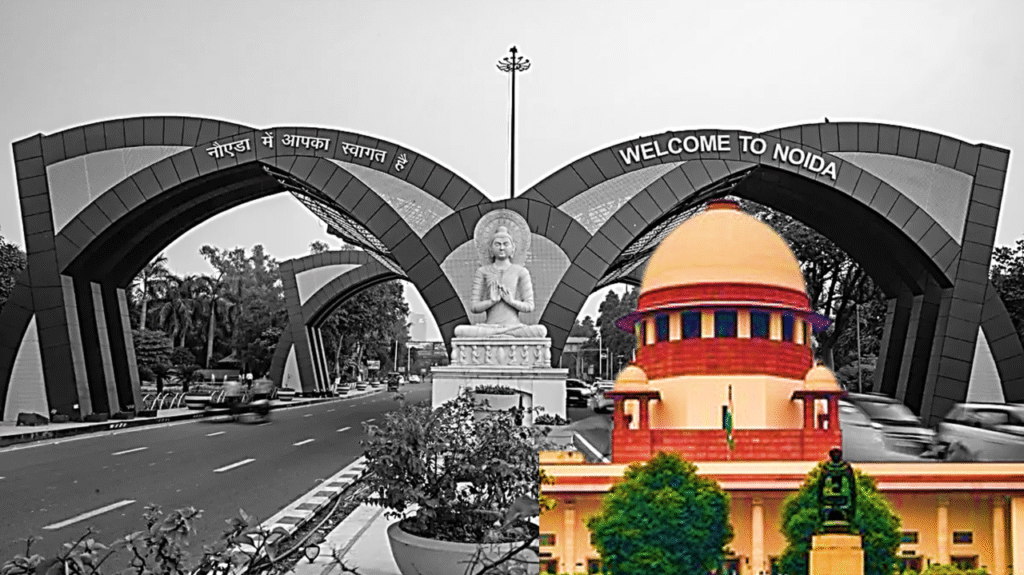
– by Ayush Kumar Singh
On 13 August 2025 the SupremeCourt accepted a Special Investigation Team’s report about NOIDA’s land-compensation practices, highlighted serious governance gaps, and issued immediate, concrete directions: a fresh SIT (headed by senior IPS officers), immediate registration of enquiries/FIRs where warranted, fast-tracked prosecution sanctions where necessary, mandatory appointment of a Chief Vigilance Officer, constitution of a Citizen Advisory Board within four weeks, and a halt on projects that lack Environmental Impact Assessments unless cleared by the Court’s Green Bench. The Court also asked the State to place the SIT report before the Council of Ministers so policy reforms such as converting NOIDA into a Metropolitan body can be considered.
How this litigation reached the Supreme Court
The petition before the bench of Justices Surya Kant and Joymalya Bagchi grew out of a sequence of concerns about the way the New Okhla Industrial Development Authority handled land compensation and allotment. The apex court had earlier tasked a Special Investigation Team to probe those concerns; the SIT submitted a comprehensive report which formed the factual basis for the August order. The central factual findings and recommendations are recorded in the court’s order of 13 August 2025, which recites the SIT’s conclusions on four discrete issues: whether quantum of compensation exceeded judicial entitlements, whether any payments were “exorbitant” and by whom such payments were authorised, whether collusion existed between beneficiaries and NOIDA officials, and whether the overall functioning of NOIDA suffered from lack of transparency and excessive concentration of discretion.
This is not the first time the matter has engaged courts. The earlier litigation, interim orders and the SIT’s initial probe set the stage for the detailed fact-finding the Supreme Court now embraces and asks the State to act on. The Court’s present order is procedural and remedial: it does not finally adjudicate guilt but it requires immediate investigative, administrative and policy follow-up.
What the SIT found
The SIT’s report, summarized in the Court’s order, contains three findings that demand attention. First, on the narrow numerical question of compensation, the SIT concluded that “enhanced compensation” was paid in 1,198 cases while court directions authorizing such payments were present in 1,167 cases; within that corpus the SIT identified 20 cases where payments were “exorbitant” or plainly excessive beyond legal entitlement. Second, for those twenty cases the SIT named officers allegedly responsible for authorizing the payments. Third, and perhaps most consequential, the SIT stated that to test collusion it was necessary to examine the financial footprints of officials, their families and beneficiary landowners bank accounts, transactions and assets stretching back over a decade and that this would require engagement of specialized forensic accounting and economic-offence expertise. Beyond isolated irregularities, the SIT also painted a governance picture: decision-making in NOIDA was concentrated, response mechanisms were reactive and slow, public reporting was limited, and the Land Allotment Committee’s composition produced a tilt in policy outcomes towards developer interests.
Put bluntly, the SIT described a mix of discrete suspect payments and an institutional culture where discretionary power was thinly checked and public scrutiny absent. Those twin strands transactional excesses in a governance vacuum are what the Supreme Court addressed in its directions.
What the Supreme Court ordered and what each direction seeks to achieve
The Court began by recording its appreciation for the SIT’s “fair and impartial” exercise, then converted the SIT’s recommendations into enforceable directions. The directions are both investigative and structural.
First, for investigation the state DGP was directed to constitute a fresh SIT of IPS officers (drawn from different state cadres). That team is to be assisted by forensic accountants and the Economic Offences Wing, and it is to immediately register FIRs where the preliminary inquiry discloses cognizable offences. Where prosecution of an officer under the Prevention of Corruption Act requires prior sanction, the competent authority must decide on the sanction within two weeks of a proper application. The head of the new SIT an officer not below Commissioner of Police must file a status report of the probe for the Court’s record. These procedural steps are intended to prevent delays in transforming findings into enforceable investigations and, if warranted, prosecutions.
Second, for administrative accountability the Court directed the Chief Secretary to place a copy of the SIT report before the Council of Ministers so that high-level policy choices such as converting NOIDA into a Metropolitan Corporation can be considered. In the interim the Court required posting of a Chief Vigilance Officer at NOIDA (an IPS officer or an officer deputed from CAG) and mandated constitution of a Citizen Advisory Board within four weeks. The purpose is to create both an institutional check inside NOIDA (the CVO) and a formal channel for resident participation and oversight (the Advisory Board).
Third, on environmental and planning safeguards the Court insisted that no project proceed without an Environmental Impact Assessment and clearance approved by the Court’s Green Bench. By attaching environmental clearance to the investigative direction, the bench made clear that development and ecological compliance are not separable. Development that bypasses impact assessment will not simply face administrative censure; the Court placed a practical brake on such projects pending proper environmental scrutiny.
Finally, the Court fixed the matter for a status hearing on 28 October 2025 and continued the interim stay until further orders. By requiring periodic reporting and by retaining supervisory control, the Court signaled it will follow up rather than simply issue a one-time diktat.
Legal and institutional implications
The order has three immediate legal consequences. First, it lowers the threshold for converting administrative findings into criminal inquiry by instructing the new SIT to register FIRs and by narrowing administrative friction: the Court requires that requests for sanction under the Prevention of Corruption Act be decided within two weeks. Section 19 of the Prevention of Corruption Act does require prior sanction for prosecution of public servants in respect of certain offences, and courts often see prosecutorial delay where administrative authorities sit on sanction requests. By setting a two-week timeline the Court is attempting to cut that delay at source and ensure that sanction becomes a procedural, not a political, bottleneck. The legal architecture remains the same sanction is still necessary where the statute requires it but the Court has insisted on speed and candour in that administrative step.
Second, the order elevates forensic financial investigation to a mainstream instrument in corruption probes involving development authorities. The SIT’s recommendation to examine bank accounts and disproportionate assets is precisely the sort of enquiry that goes beyond ledger checks into forensic reconstruction of transactions. Such work requires specialized investigators and cross-agency coordination (for example, Economic Offence Wings, forensic accountants, and perhaps central agencies where inter-state banking trails exist). The Court’s direction makes the State accountable for arranging those capabilities quickly.
Third, the direction to consider structural reform primarily the possibility of replacing the NOIDA Authority with a Metropolitan Corporation raises statutory and policy questions. A metropolitan body with civic representation would shift decision-making away from a predominantly bureaucratic and developer-oriented model to a more representative architecture, but that change cannot be effected by judicial fiat alone: it will require political will and amendments to the Uttar Pradesh Industrial Area Development Act (the enabling statute that governs authorities like NOIDA). The Court’s order therefore functions as a catalyzer for political and legislative action while simultaneously insisting on interim administrative protections (the CVO and CAB) that the State can implement immediately.
Why the Court’s insistence on transparency and citizen participation matters
The SIT’s account and the Court’s response are not abstract debates about administrative form. They touch the lived experience of residents, the price of land, and the integrity of urban planning. When discretionary power is concentrated and public reporting sparse, disputes over valuation and allotment escalate quickly into allegations of favoritism, unaccounted gains, and erosion of public trust. The Court’s insistence on a Citizen Advisory Board and on public reporting is a practical attempt to reintroduce transparency into daily governance: citizen scrutiny, regular public meetings and third-party audits make it harder for suspicious transactions to be hidden behind technicalities. The order therefore attempts to counter both specific wrongs (the identified payments) and the systemic opacity that made those wrongs possible.
Practical problems the order will encounter, and why implementation will be decisive
Strong judicial directions are necessary, but not sufficient. Three practical problems will determine whether the order produces durable reform.
First, political and bureaucratic resistance is real. Institutional reforms especially ones that dilute discretionary privilege or alter the architecture of powerful authorities require sustained political will. Converting NOIDA into a metropolitan body implicates state legislation, administrative reallocation, and local politics; the Court can urge a policy choice but only the executive and legislature can fully implement that structural change. News reporting already flags that legal change will be required and that implementation will depend on the State’s appetite for reform.
Second, capacity constraints may frustrate forensic work. Forensic accounting, inter-bank transaction reconstruction and complex disproportionate assets investigations need resources and specialist manpower. If the State fails to equip the SIT with trained economic-offence experts or delays access to records, the inquiry’s quality will suffer. The Court’s demand for rapid action is only meaningful if the SIT has real investigatory capacity.
Third, citizen participation must be more than tokenism. Creating a Citizen Advisory Board is sensible, but unless the board has access to information, a clear mandate, and mechanisms to influence decisions its presence may be symbolic. The Court’s direction is strongest when combined with open data land-acquisition records, compensation schedules, project approvals and EIA reports published on searchable public dashboards so that citizens and the media can do real oversight work. Coverage in national outlets has already emphasized this point: the CAB will only be effective if it is operationally meaningful.
What this judgment means for practitioners, policymakers and residents
For lawyers and litigators, the order opens multiple avenues. Public interest litigation and follow-on petitions will test the quality and speed of the SIT’s work; affected landowners may seek corrective relief if the forensic enquiry reveals overpayments without lawful basis; and officials who face investigation will need counsel to respond both to administrative probes and, if charges are framed, to criminal proceedings where prior sanction issues may arise. For policymakers, the order is a prompt to draft operational rules for citizen participation, to resource forensic and environmental review capacities, and to begin the legislative work needed for any structural transformation. For residents, the judgment offers a roadmap toward accountability but it also asks residents to insist on transparency and to use the CAB and information tools the State must now create.
What should happen next?
The State must constitute the new SIT and ensure it has forensic accountants and EoW officers; when the SIT finds prima facie evidence it should not be allowed to stall at the sanction stage; the Chief Secretary must place the report before the Council with a clear timeline for decisions about metropolitan conversion; the CVO post must be filled with powers and resources and the Citizen Advisory Board set up with a public mandate, transparent selection norms and access to records; the NOIDA authority must publish its acquisition and allotment records and EIA documentation online; and, critically, the Green Bench clearance regime must be made operational so that environmental scrutiny is not a mere formality. The Court has provided the architecture; success will depend on the unglamorous work of implementation.
Concluding reflection
The Supreme Court’s order in Virendra Singh Nagar v. State of Uttar Pradesh is serious because it blends three things’ courts rarely do with such immediacy: careful factual acceptance of a technical SIT report, a demand for swift criminal and forensic follow-up, and an insistence on structural reform that cannot be postponed. The bench did not stop at asking for another probe; it set deadlines, demanded institutional fixes, and required environmental safeguards.
For NOIDA this is a watershed moment how the State, the Authority, residents and civil society respond between August and the next hearing on 28 October 2025 will determine whether the judgment catalyses real governance reform or merely produces another round of short-lived headlines. The order places a premium on transparency, forensic inquiry and public participation. If those requirements are met in spirit, the judgment can help reset the balance between development and accountability in one of India’s fastest growing urban regions.